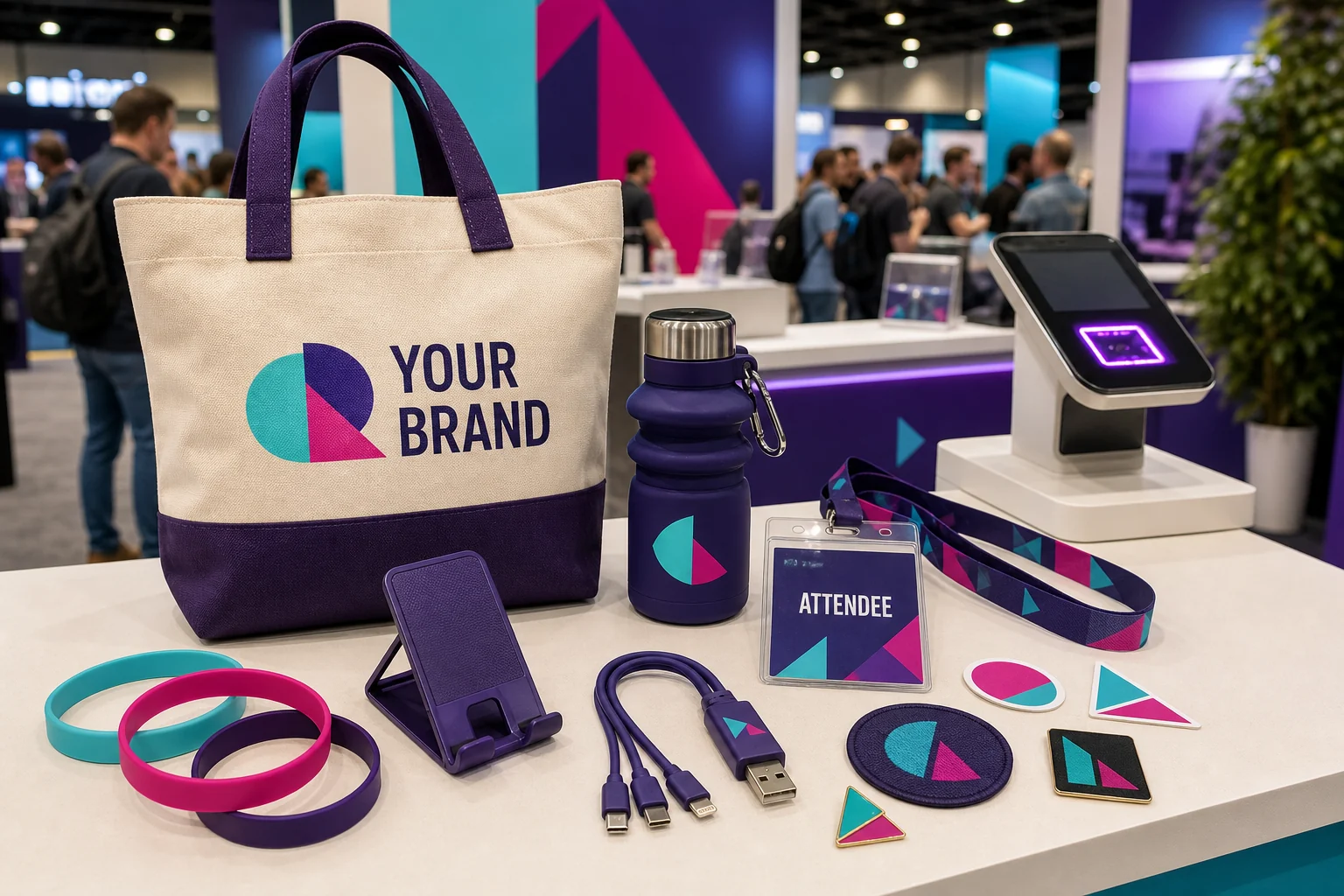
The same trade show can contain three very different audiences: people passing the booth, prospects comparing suppliers and priority contacts you want to move to a serious next step. Handing every person the same item is simple, but it can spend the budget without creating the conversation the team needs.
Quick answer
Choose the giveaway after you define the visitor action. A general attendee item should be easy to carry and relevant to the event day. A more valuable item should have a clear distribution rule tied to a real conversation, a demonstration, a qualified lead or a booked follow-up.
Start with the booth action, not the product
“More traffic” is not a complete objective. Decide what you need the attendee to do: notice a message, start a short conversation, see a demo, leave contact details, book a meeting or receive a follow-up. The giveaway should make that next action easier rather than becoming the whole reason for the stop.
| Booth objective | Giveaway role | Useful action to connect |
|---|---|---|
| Awareness | Give attendees a simple, useful reason to remember the booth. | Read a short value statement or see a quick product demonstration. |
| Conversation | Reward a relevant exchange without making it feel like a transaction. | Answer one qualifying question or share the problem they are solving. |
| Qualified lead | Use a more considered item for prospects with a genuine fit. | Scan details, arrange a follow-up or request a demo. |
| Priority account | Create a deliberate client or prospect presentation. | Book a meeting or deliver the item as part of a planned visit. |
Use three practical giveaway tiers
For general visitors
Keep it compact, easy to hand out and useful during or after the event. Confirm it will not create unnecessary booth storage or carrying problems.
For relevant booth engagement
Use an item with more perceived value after a demonstration, a meaningful conversation or a relevant contact exchange.
For target accounts
Plan a focused gift, sample or kit for scheduled meetings and priority prospects rather than placing it in general booth stock.
For all three tiers
Use a consistent logo treatment and campaign message so the programme feels intentional even when product values differ.
Choose an item people can use at this event
A useful item can still fail if it is awkward to carry through a crowded hall, too large for the attendee’s luggage or disconnected from the audience. Think through the moment of use: at the booth, in a hotel, on the journey home, at a desk or in the field.
- For travel-heavy events, consider whether the product is compact, durable and easy to pack.
- For desk-oriented visitors, focus on practical workday use rather than novelty.
- For a drinkware route, confirm capacity, lid behaviour, cleaning and logo scale before selecting an imprint.
- For a VIP kit, include fewer pieces with clear roles and packaging that protects the items.
Use the branded drinkware retention scorecard when a tumbler, bottle or mug is part of the event plan.
Write the distribution rule before ordering
The most effective giveaway rule is visible to the team, easy to explain and proportionate to the product. Do not make a small item feel difficult to obtain, but do not give away a meaningful budget item before the relevant visitor action happens.
- Define the three visitor groups and the item each group can receive.
- Give booth staff a one-line rule for each item.
- Connect the higher tiers to a demonstrable visitor action or planned meeting.
- Prepare a lead-capture and follow-up process before the doors open.
- Track distribution and remaining stock daily so the event team can adapt.
Why exhibitors are discussing this now
Recent exhibitor conversations focus less on finding a magical giveaway and more on whether the item supports a clear booth goal. People weigh cost against lead value, question generic QR-code tactics and look for useful products that visitors will keep. These discussions are qualitative signals, not a universal conversion benchmark.
Prepare a recommendation-ready sourcing brief
- Event name, dates, venue and required delivery date.
- Who receives each tier and what action qualifies them.
- Target quantities for general, conversation and priority stock.
- Desired product use setting, logo file and campaign message.
- Booth storage limits, individual packing needs and onward travel considerations.
- Destination address, budget direction and any existing product preferences.
Explore the current trade show giveaway kit directions for product starting points. Specific materials, decoration, MOQ, packing and availability are confirmed for the selected project before quotation.
Build a trade show giveaway plan with a purpose.
Share the event, audience, target quantity and desired visitor action. We can help turn that into a practical product and distribution brief.
Frequently asked questions
Do trade show giveaways drive conversions?
They can support conversations and follow-up, but do not replace a clear booth message, relevant offer or lead-capture process.
Should every visitor receive the same giveaway?
Not always. Tiered distribution can reserve more considered products for qualified conversations, booked meetings or priority accounts.
What should a trade show giveaway brief include?
Include the event, attendee type, quantity, distribution rule, product use setting, logo, booth storage limits, packing, delivery address and required date.
How can exhibitors avoid attracting only freebie hunters?
Put the main giveaway behind a useful interaction such as a demo, qualifying conversation, scan-and-follow-up step or booked meeting.
Give visitors a reason to talk, not only something to carry away.
A clear action and an appropriate product tier turn giveaway spend into a more deliberate event programme.