Drinkware decoration is not a menu where every method works equally well on every cup. Stainless steel, powder coating, plastic, glass and ceramic respond differently. Logo detail, colour count, wrap area, quantity and expected handling also change the recommendation.
Quick answer
Use laser engraving for a permanent, precise mark on compatible metal or coated drinkware. Use UV printing when selected surfaces and detailed full-colour artwork are compatible. Use screen printing for clean, repeatable solid-colour logos. Use high-temperature decals for suitable ceramic mugs. Confirm adhesion, appearance and printable area on the exact product before production.
Decoration methods at a glance
| Method | Best starting use | Key strength | Confirm before approval |
|---|---|---|---|
| Laser engraving | Compatible stainless steel and coated metal | Precise, permanent mark without ink colours | Engraved colour, coating response and placement |
| UV printing | Selected hard surfaces and detailed artwork | Full colour, gradients and fine detail | Adhesion, primer, curing, white ink and wrap limits |
| Screen printing | Simple logos and repeat production | Strong solid colours and practical unit production | Ink system, colour count, registration and curvature |
| High-temperature decal | Compatible glazed ceramic | Fired decoration integrated with the ceramic process | Firing result, colour shift and printable area |
| Adhesive label | Short-run campaigns and selected bottles | Fast detailed graphics without direct cup printing | Label material, seam, moisture and intended lifetime |
Laser engraving: durable and precise
Laser engraving uses focused energy to remove or alter the surface of compatible drinkware. On a powder-coated stainless steel tumbler, the process commonly reveals the underlying material. On bare metal, the result can look different depending on the alloy and machine settings.
Choose laser when
- The artwork is one-colour line art, a wordmark or a simple emblem.
- A permanent mark is more important than full brand colour.
- The selected material and coating produce an acceptable contrast.
- The design fits within a controlled marking area.
Laser is not automatically the best choice for every premium project. It cannot reproduce brand colours, and a very large engraved area may look different across curved surfaces. Ask for a digital position proof and, when colour contrast matters, a pre-production sample on the exact finish.
UV printing: detailed full colour on selected surfaces
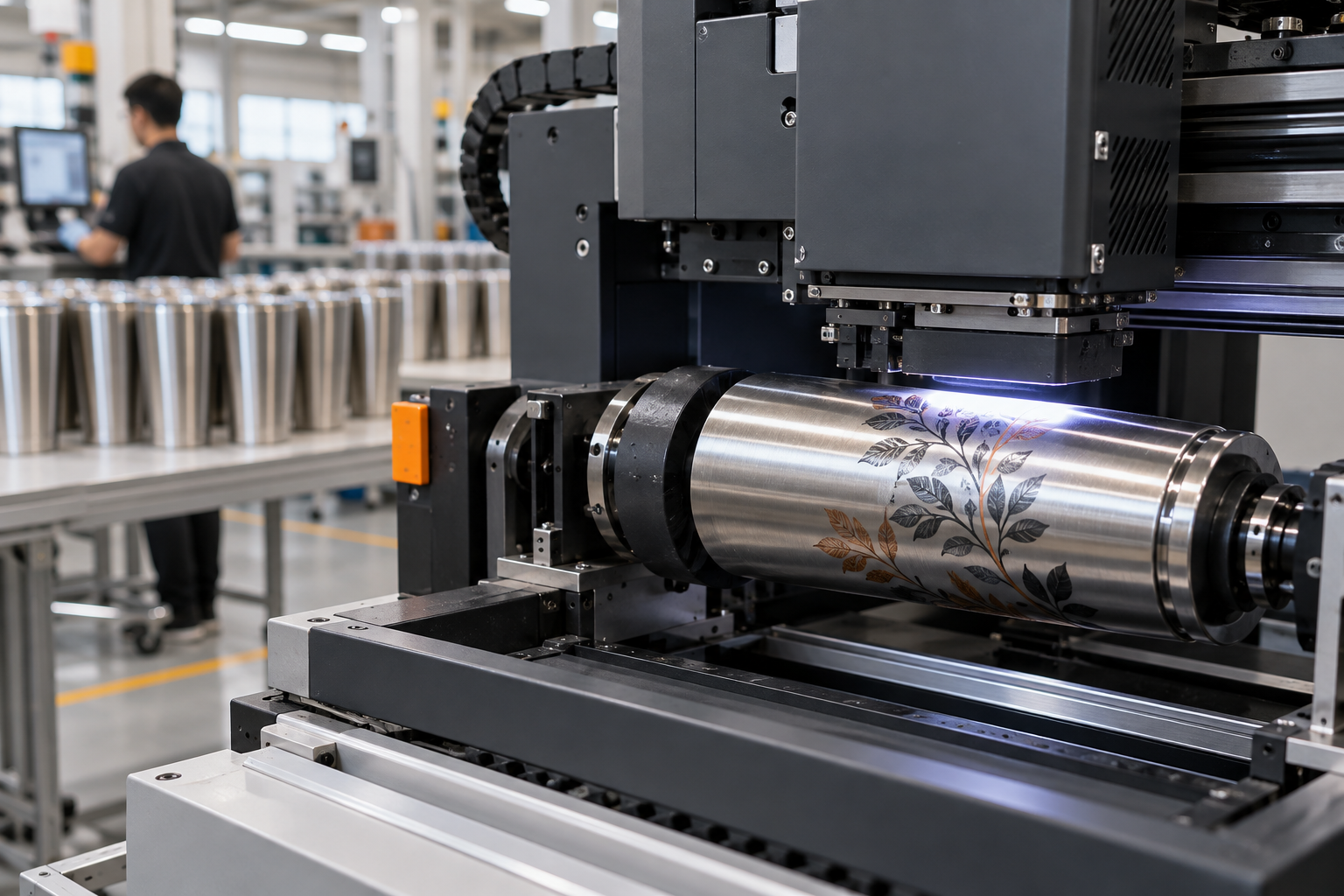
UV printing places ink on the surface and cures it with ultraviolet light. It can reproduce gradients, fine detail and multi-colour artwork that laser cannot. Rotary or cylindrical equipment helps control the print on suitable cup shapes.
Choose UV when
- The artwork requires multiple colours, gradients or fine detail.
- The cup surface has been confirmed for the ink and pretreatment route.
- A white ink layer is needed beneath colour on a dark cup.
- The approved print area does not conflict with handles, tapering or seams.
Adhesion is the key qualification. Surface energy, coating, cleaning, primer and curing all affect the result. A successful print on one powder coating does not prove compatibility with another. Request an adhesion check or sample for the exact substrate, especially when the cups will receive frequent handling.
Screen printing: efficient for clear, simple logos
Screen printing transfers ink through a prepared mesh screen. It is a practical option for solid-colour logos and repeat production, provided the cup curvature and coating are suitable. Each colour generally requires its own screen and registration step.
Choose screen printing when
- The logo uses one or a few solid colours.
- The artwork can tolerate the available line and detail limits.
- The order quantity supports screen setup.
- The desired placement fits the printable arc of the cup.
Fine reverse lines, tight colour registration and wide wraps can be challenging on cylindrical shapes. Handles and changing diameters reduce the usable area. Provide vector artwork and allow the production team to adjust small details if required for consistent printing.
High-temperature decal for ceramic mugs
A high-temperature decal is applied to suitable ceramic drinkware and fired so the decoration bonds through the ceramic finishing process. It can be a strong route for mug artwork that needs more detail than a simple direct print.
Firing can shift some colours, so physical colour expectations should be agreed before mass production. The mug glaze, decal system, firing curve and artwork all matter. For ceramic items, also confirm whether the decoration is suitable for the intended washing and use conditions.
Why production discussions disagree
Printing professionals often give different answers because they are thinking about different substrates, equipment, order volumes and end uses. Community discussions reinforce the need to start with the exact cup and artwork rather than declaring one universal “best” process.
- Commercial printing discussion comparing laser, screen and UV
- Discussion of cylindrical stainless tumbler printing
These discussions are demand and practitioner signals, not specifications for a particular product.
Choose the method with five project facts
What is the cup made and coated with?
Specify stainless steel, plastic, glass or ceramic, plus powder coat, paint, glaze or bare finish.
How many colours and how much detail?
Provide vector artwork where possible and flag gradients, photographs, fine lines and exact brand colours.
How far must the graphic wrap?
Show the intended front, opposite-handle, two-side or wrap position rather than saying “large logo.”
How will the cup be handled and cleaned?
Tell the supplier about frequent washing, outdoor use, gift presentation and the expected service life.
What production route makes sense?
Setup, colour count and sampling decisions change with quantity and deadline.
What must the proof show?
Confirm logo size, position, colour reference, orientation and method on the order record.
What to approve before production
- Product code and finish: the exact cup, colour and coating.
- Decoration method: not only “printed logo.”
- Artwork version: file name, colours and any adjusted minimum line weights.
- Logo size and coordinates: including orientation relative to the handle.
- Colour expectation: Pantone reference where relevant, with a note that substrate affects appearance.
- Sample route: digital proof, existing sample, blank sample or decorated pre-production sample.
- Care statement: confirmed for the cup, lid, coating and decoration as separate components.
See the current Drinkware decoration capabilities and selected custom cup formats. If you are still choosing a capacity, compare 30 oz and 40 oz custom tumblers.
Match the logo to the cup surface
Send the product image or cup type, artwork, quantity and target date. We will identify the practical decoration routes before the quote is finalized.
Frequently asked questions
Which printing method is best for stainless steel tumblers?
Laser is a strong choice for a permanent single-colour mark on compatible surfaces. UV can reproduce detailed full colour, while screen printing suits simple solid-colour logos. The exact coating, artwork and quantity decide the route.
Is laser engraving more durable than printing?
It can be highly durable because it alters or removes the compatible surface rather than adding ink. Appearance and performance still depend on the material and coating.
Can UV printing reproduce gradients?
Yes, on selected compatible surfaces. Adhesion, white ink, colour appearance and print-area limits should be tested on the exact cup finish.
When is screen printing suitable?
It is often practical for one or a few solid colours and repeat quantities, subject to curvature, coating, registration and printable-area limits.
What method is common for ceramic mugs?
High-temperature fired decals are a common route for compatible glazed ceramic, although other methods may also be available.
Approve a decoration route, not just a logo mockup.
Selected custom drinkware starts from 100 pieces. We confirm the cup, surface, artwork, placement and production method together before mass production.